
Tesla Powerwall vs Sungrow vs Enphase, which home battery for Australia in 2026?
The three battery brands most Aussie installers quote on. Different storage models, different price points, different lifespans. Here's how they really compare for an Australian home in 2026.
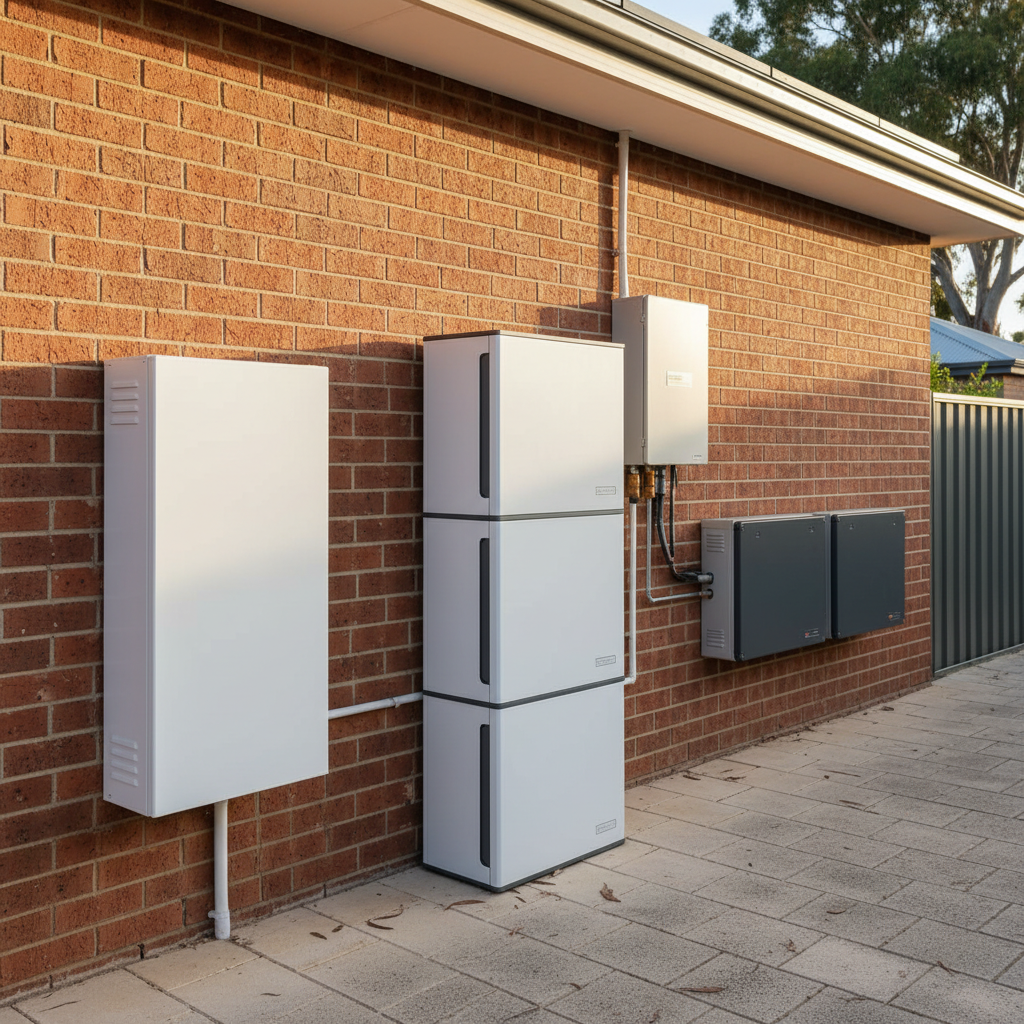
Three brands dominate the Australian home battery market in 2026: Tesla, Sungrow, and Enphase. They take different approaches (single-unit, modular, micro-battery) and the right pick depends on your house, your solar setup, and your budget.
The three at a glance
| Tesla Powerwall 3 | Sungrow SBR (modular) | Enphase IQ Battery 10 | |
|---|---|---|---|
| Usable capacity | 13.5 kWh | 9.6 to 25.6 kWh (modular) | 10.08 kWh per unit |
| Max continuous power | 11.5 kW | 6 kW (per inverter) | 3.84 kW |
| Backup capability | Yes, whole-home | Yes, with extra backup module | Yes, requires backup box |
| Approx installed cost (after CHBP) | $13,000 to $17,000 | $11,000 to $16,000 | $12,000 to $16,000 |
| Inverter | Built-in (DC) | Separate (hybrid SH series) | Built-in micro-inverters |
| Indoor/outdoor | Both | Indoor only | Both, IP55 |
| Modular | No (one unit) | Yes (3.2 to 25.6 kWh) | Yes (per 10.08 kWh) |
| Lifespan warranty | 10 years | 10 years | 10 years (15 on inverter) |
| Best for | Whole-home backup + big loads | Modular sizing, lower-budget | High-reliability, redundancy |
Tesla Powerwall 3
The market-leading single-unit battery in Australia. Built-in DC-coupled inverter, 11.5kW continuous output, 13.5kWh usable. Big enough to handle whole-home backup including air conditioning starts.
Strengths:
- Single unit, simple install (one box on the wall)
- Strong continuous power output (runs ACs, ovens during a blackout)
- Best app experience in the market
- Best resale value if you sell the house
- Tesla VPP eligible in some states
Weaknesses:
- Not modular, you buy the full 13.5kWh whether you need it or not
- Indoor or outdoor but not under direct sun (heat derates it)
- DC-coupled means it works best with new solar; retrofit to existing solar needs an extra DC charger
- Limited installer network compared to Sungrow
Sungrow SBR
A modular system: buy 3.2kWh, 4.8kWh, 6.4kWh, 9.6kWh modules and stack them. Total capacity 3.2 to 25.6 kWh per cabinet. Pairs with Sungrow’s SH hybrid inverter.
Strengths:
- Modular, sized to your house
- Lower entry cost (start at 6.4kWh)
- Strong Australian installer network
- Hybrid inverter handles solar and battery on one device, cleaner switchboard
- Sungrow brand has strong service support in Aus
Weaknesses:
- Requires Sungrow SH hybrid inverter (not cheap to add if you have a different inverter)
- Indoor only (in garage or laundry typically)
- 6kW continuous output (single inverter), less headroom than Powerwall for big motor starts
- Backup capability requires an additional backup interface module ($1,500 to $2,500)
Enphase IQ Battery 10
Modular at the 10.08kWh per-unit level. Each unit has multiple internal micro-batteries with their own micro-inverters. Pairs with Enphase IQ8 micro-inverters on the solar side for a fully Enphase ecosystem.
Strengths:
- Highest redundancy: if one micro-battery fails, the others keep working
- Best for partial-shade or panel-orientation-varied solar systems (when paired with Enphase micros)
- Outdoor-rated (IP55)
- 15-year warranty on the micro-inverter side (industry-leading)
Weaknesses:
- Lower continuous output, 3.84kW per unit, two units required for whole-home backup
- More expensive per kWh than Tesla or Sungrow
- Less suitable for big single-shot loads (AC start, oven)
- Best results require Enphase micro-inverters on solar (Enphase ecosystem play)
Which to pick for your situation
| Your situation | Probably best |
|---|---|
| Want whole-home backup including AC and oven | Tesla Powerwall 3 |
| Want to start small and grow | Sungrow SBR (modular) |
| Have shaded or complex roof orientation | Enphase (with Enphase micros) |
| Want lowest entry cost | Sungrow SBR (6.4kWh) |
| Want best app and resale value | Tesla Powerwall 3 |
| Want maximum redundancy / fail-soft | Enphase IQ Battery 10 |
| Already have an Enphase micro-inverter solar system | Enphase IQ Battery 10 |
| New build, all electric, single-phase | Tesla Powerwall 3 or Sungrow |
Federal Cheaper Home Batteries Program (2025 onwards)
The federal program launched mid-2025 covers about 30% of battery system costs through STCs. As of 2026 it’s still running but rates step down over time. A 10 to 13kWh battery system that retailed at $14,000 to $20,000 pre-CHBP now lands at $10,000 to $14,000 installed after rebate.
State schemes (NSW Empowering Homes, VIC Solar Homes) sometimes stack on top. Check current state rebates before quoting.
Choosing an installer
All three brands have accredited installer networks. The installer matters as much as the brand:
- Brand-accredited? (Tesla Energy Certified, Sungrow Premium, Enphase Platinum)
- CEC-accredited installer with battery storage endorsement?
- Number of installs of your chosen brand (ask for 3 references)?
- Warranty on workmanship (5 years minimum from a quality installer)?
What’s NOT in this comparison
This article covers the three most-installed home battery brands in Australia. There are other options worth a look:
- BYD Battery-Box (Chinese, modular, cheaper per kWh, strong battery industry roots)
- Alpha ESS (popular budget option with growing installer network)
- Solax Triple Power (often paired with Solax inverters, mid-market)
- PylonTech (popular with off-grid and hybrid installers, very modular)
These can be the right pick if budget is the dominant factor or you’re working with a specific installer’s preferred brand. Tesla, Sungrow, and Enphase remain the safest defaults for most Australian families.
Frequently asked questions
Is a home battery worth it for an Aussie household in 2026?
Depends on your solar export rate and electricity tariff. With feed-in tariffs now under 5c/kWh in most states and grid power at 30 to 45c/kWh, a battery pays back in 7 to 12 years for most homes with 6kW+ solar. Federal Cheaper Home Batteries Program incentives from mid-2025 onwards have shortened that significantly.
Which battery has the longest warranty?
All three offer 10-year warranties. Tesla and Sungrow guarantee 70% capacity retention at year 10. Enphase guarantees 70% at year 10 for the IQ Battery 10.
Can I add a battery to my existing solar?
Yes. AC-coupled batteries (Tesla Powerwall, Enphase) work with any existing solar inverter, no inverter change required. DC-coupled options (Sungrow, with their hybrid inverter) usually need a new hybrid inverter. AC-coupled is simpler for retrofits; DC-coupled is slightly more efficient for new installs.
What about cheaper Chinese brands?
Aussie market has plenty of cheaper brands (BYD, Alpha ESS, Solax). They often work fine but warranty support and longevity are less proven. Tesla, Sungrow, and Enphase have established Aussie installer networks and post-sale support.