
Type 1 vs Type 2 EV charging, what every Aussie EV owner should know
Australia uses Type 2 for AC charging on every new EV. Here's what that means for buying a charger, plus the CCS2 standard for DC fast charging.
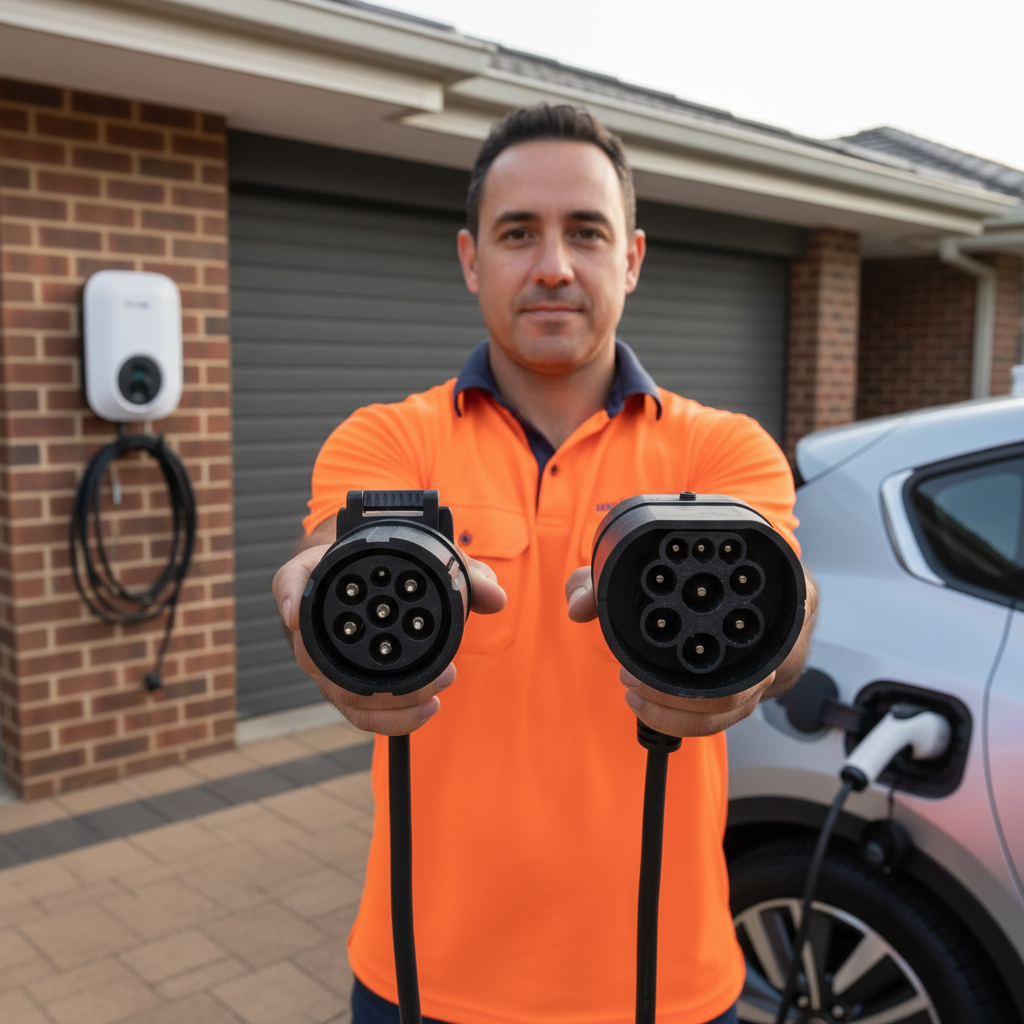
EV charging standards confuse new owners. The good news for Australians: we settled on Type 2 (AC) and CCS2 (DC fast) and most other compatibility headaches went away with it.
The standards in Australia in 2026
| Standard | What it does | Used by |
|---|---|---|
| Type 2 (AC) | Slow to medium home and public charging, 7 kW to 22 kW | Every new EV sold in AU since 2018 |
| CCS2 (DC) | Fast public charging, 50 kW to 350 kW | Tesla, Hyundai, BMW, Audi, Volvo, Polestar, Ford, BYD, MG, etc. |
| Type 1 (AC) | Older AC standard, North American origin | Older Nissan Leaf (pre-2018), older Mitsubishi Outlander PHEV |
| CHAdeMO (DC) | Older DC fast standard, Japanese | Older Nissan Leaf, some 2010s Mitsubishis |
For practical purposes in Australia in 2026: Type 2 + CCS2 is the standard. Any new EV you buy will use these.
Home charging: AC Type 2
Home chargers are AC. They draw from your house’s mains supply and feed AC into the car, which the car’s onboard charger converts to DC for the battery. Speeds:
- Single-phase 7 kW: most common Aussie home charger. Charges a typical 60 kWh battery from empty in 8 to 10 hours. Overnight = full
- Three-phase 11 kW: if you have three-phase to your house, faster home charging. Charges in 5 to 7 hours
- Three-phase 22 kW: max practical home charging. Less common because not every EV’s onboard charger accepts 22 kW
Buying decision for home: 7 kW Type 2 is enough for 95% of Australian households. Three-phase is for fleet use or specific EVs (older Renault Zoe, certain Audi e-tron) that benefit from higher AC charge rates.
Cost to install at home: $1,200 to $3,500 typically. Full breakdown in our EV charger install cost guide.
Public charging: AC and DC
| Type | Speed | Where you find it | Typical cost |
|---|---|---|---|
| AC Type 2 (3 to 7 kW) | Slow | Shopping centre car parks, hotels | $0 (free destination) to 30c/kWh |
| AC Type 2 (11 to 22 kW) | Medium | Some public chargers | 30c to 50c/kWh |
| DC CCS2 (50 kW) | Fast | Highway stops | 50c to 70c/kWh |
| DC CCS2 (150 kW) | Very fast | Highway stops, premium | 60c to 85c/kWh |
| DC CCS2 (350 kW) | Ultra-fast | Tesla Supercharger v3+, Chargefox highway | 70c to 95c/kWh |
Aussie public charging networks: Chargefox, Evie Networks, NRMA, Tesla Supercharger, Ampol AmpCharge, BP Pulse, Engie, JOLT.
Tesla Supercharger access for non-Teslas in Australia
Tesla has been opening Supercharger access to non-Tesla CCS2 vehicles in Australia since 2023. Use the Tesla app, no Tesla membership needed. Pricing typically 65 to 80c/kWh, sometimes cheaper than premium third-party networks.
What this means for buying an EV in 2026
Don’t worry about charging standards. Any new EV sold in Australia uses Type 2 + CCS2 and works at every public charger here. Charging compatibility used to be a real concern in the 2017 to 2020 transition era. It’s a non-issue now.
What still varies between cars:
- Onboard AC charger size: limits home charging speed (7, 11, or 22 kW)
- Maximum DC charge speed: some EVs cap at 50 kW, others handle 200 kW+
- Charge curve: how quickly speed drops as battery fills (affects highway trip planning)
Look up your specific model on the manufacturer site. Charging standards are universal; charging speeds are model-specific.
Tethered vs untethered home chargers
When buying a home charger:
- Tethered: cable is permanently attached to the wall unit. Convenient (don’t need to fetch the car’s cable), but stuck with that connector type
- Untethered (socket only): no cable, you bring the car’s own cable each time. Future-proof against connector changes, slightly less convenient
In 2026 Australia, Type 2 is locked in for at least the next decade, so tethered Type 2 is a safe choice.
Frequently asked questions
Are all EVs in Australia Type 2?
Almost all new EVs sold in Australia since 2018 use Type 2 (Mennekes) AC charging and CCS2 for DC fast charging. The exceptions are older Mitsubishi Outlander PHEVs and some older Nissan Leafs that used Type 1 / CHAdeMO. Tesla in Australia uses Type 2.
Do I need a Type 1 or Type 2 home charger?
Type 2 for almost every EV bought in Australia in the past 6 years. Type 1 chargers are still on the market but suit only older vehicles. If you own a 2019+ EV, buy Type 2.
What about CCS vs CHAdeMO for DC fast charging?
CCS2 (the Type 2 socket plus two large pins below) is now the standard for DC fast charging in Australia. Tesla, Hyundai, BMW, Audi, Volvo, Polestar, Ford, BYD all use CCS2. CHAdeMO is legacy (Nissan Leaf older models) and being phased out.
Can I use a different brand of cable with my EV?
Yes for tethered Type 2 connections, any Type 2 cable plugs into any Type 2 car. Bring your own cable to any public AC charger. Adapters between Type 1 and Type 2 exist but are best avoided for daily use.