
Why an EV charger install is not just a fancy powerpoint
A home charger pulls hard, continuously, for hours. That changes everything about the circuit a sparkie has to run.
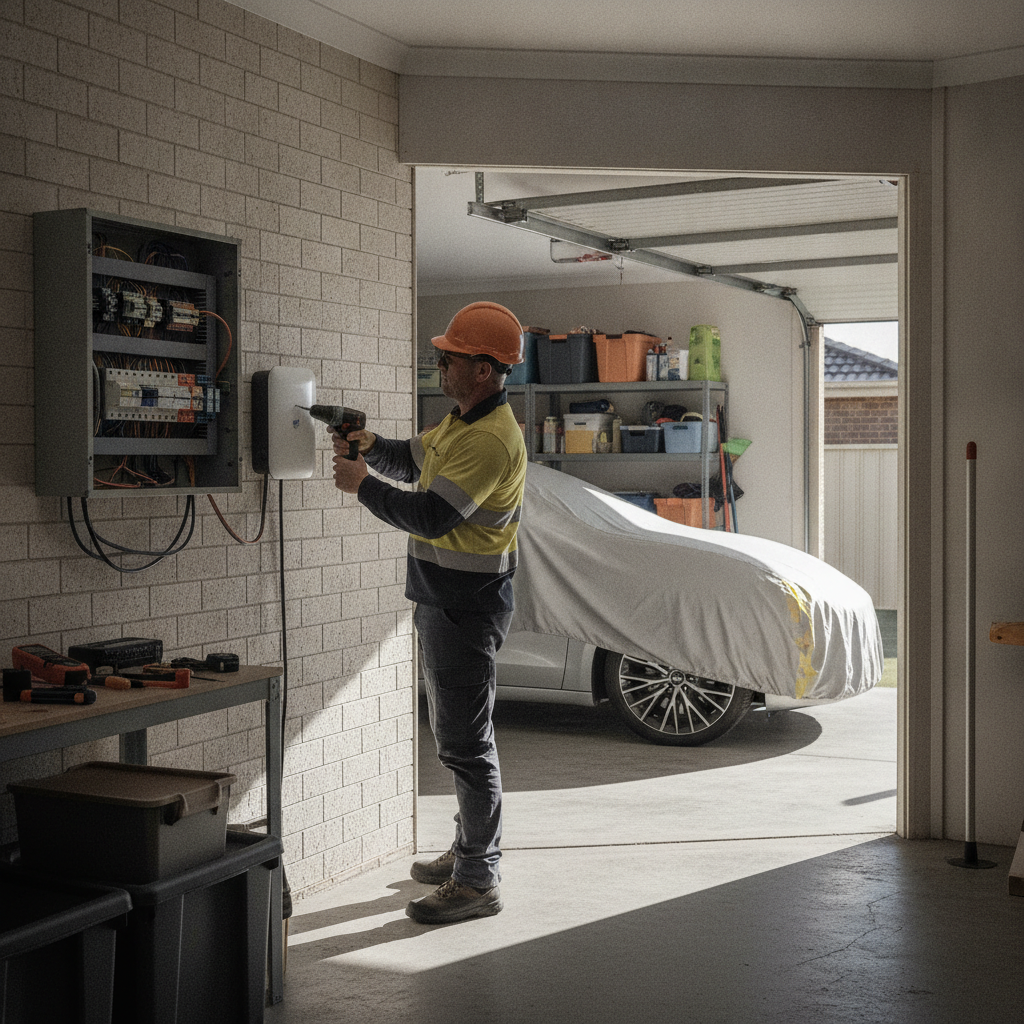
A standard powerpoint is built for short bursts. You plug in a kettle, it runs for a few minutes, then it stops. An EV charger is the opposite. It draws a heavy load, steadily, for hours at a time, often overnight. That single difference drives almost every decision an electrician makes on an EV install.
It needs its own circuit
A typical 10A general power outlet is not designed to sit near its limit for six or eight hours straight. A home charger commonly runs at 32A on single phase, around 7kW, and three-phase units go higher again. That means a dedicated circuit back to the switchboard, correctly sized cable for the run length, and its own protective device. Sharing it off an existing ring is asking for nuisance trips at best and overheating at worst.
Protection and the switchboard
Under the wiring rules, the charging circuit needs proper RCD protection. Many EV units expect a Type A RCD, and some require Type B depending on how the charger handles DC fault current, so the spec sheet matters before you quote. It is also the moment to look hard at the board. Older switchboards with little spare capacity, no main switch headroom, or tired busbars often need an upgrade before a 7kW continuous load goes anywhere near them.
Supply capacity and load management
The other question is whether the property can actually carry the extra draw, especially if there is already ducted air conditioning, an electric hot water system and an induction cooktop. This is where load management earns its keep. A charger with dynamic load balancing can throttle itself when the rest of the house ramps up, which can save a customer from an expensive supply upgrade.
What it means for the trade
EV work is steady, repeatable and only growing as more utes and family cars go electric. The installers who win the repeat work are the ones who treat it as a proper circuit design job, not a powerpoint swap: check the board, size the cable, get the RCD right, and document it. Cutting corners on a continuous high-current load is exactly how you end up back on site for the wrong reasons.
Frequently asked questions
Can an EV charger run off a normal powerpoint?
A 10A general powerpoint can trickle-charge in an emergency, but it is not designed for the continuous high-current load of a dedicated charger and should not be relied on. A proper home charger needs its own circuit.
Does an EV charger need a switchboard upgrade?
Often, yes. Older boards with little spare capacity or no main-switch headroom usually need an upgrade before a 7kW continuous load is added.