
How much does it cost to rewire a house in Australia in 2026?
Rewiring is one of the biggest electrical jobs you'll ever pay for. Expect $7,000–$25,000 depending on size, condition, and state. Here's what drives the price.
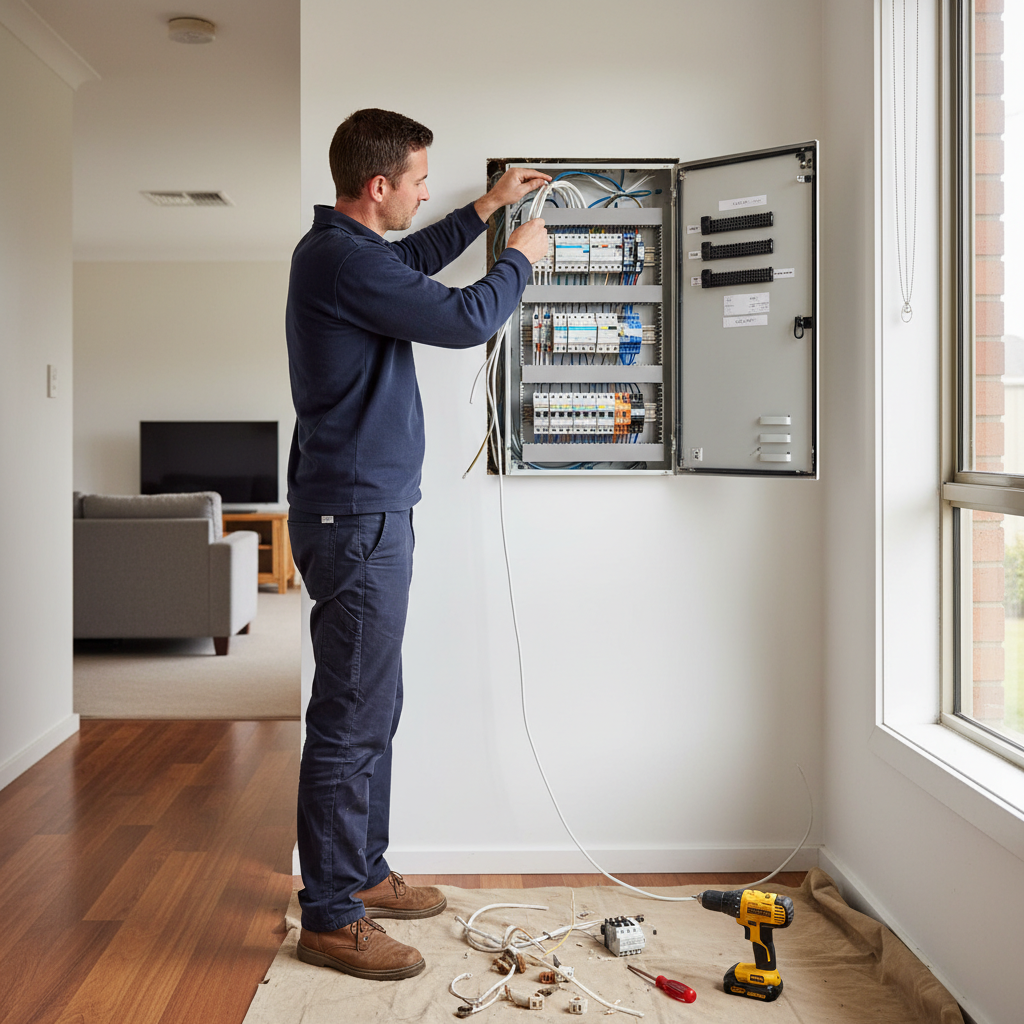
Rewiring is the most expensive electrical job most Australians ever pay for, and the most important one in older houses. Get it right and you’ve added decades of safety and resale value. Skip it when it’s needed and you’re risking a house fire.
This is a national 2026 cost guide based on typical residential pricing. Your state, your house size, and your existing condition will move the number, sometimes a lot.
The range
| House size | Realistic cost range (AUD, including GST) |
|---|---|
| Studio / 1-bed apartment | $4,000–$8,000 |
| 2-bedroom house | $6,000–$12,000 |
| 3-bedroom house (most common) | $8,000–$18,000 |
| 4-bedroom house | $12,000–$25,000 |
| Large 5+ bed house | $18,000–$40,000+ |
| Heritage / double-storey | Add 30–50% |
Wide range because so much depends on existing condition, accessibility, and what gets included.
What’s actually included in a full rewire
A proper rewire isn’t just “new cable behind the walls”. It typically includes:
- New main switchboard with RCBO/RCD protection on every circuit
- New sub-main from the meter to the board (if not already adequate)
- All power circuits replaced (typically 4–6 in a 3-bed house)
- All lighting circuits replaced (typically 2–4 in a 3-bed house)
- All GPOs and switches replaced
- Smoke alarms updated to current standard (10-year photoelectric, interconnected)
- Earthing system updated (MEN connection, earth electrode)
- Electrical inspection and Certificate of Compliance for the full property
That’s why the bill runs five figures. The cable itself is a small part of the cost, labour and switchboard parts dominate.
What drives the price up
- Plaster walls + no roof space access, labour to chase cables doubles or triples
- Double-storey, running between floors is harder
- Heritage cornices and decorative ceilings, extra care to avoid damage
- Asbestos in walls or ceiling sheeting, needs licensed asbestos removal, $2,000–$10,000 on top
- Solid brick walls (no cavity), surface conduit may be needed, or detailed routing
- 3-phase upgrade, if going from single to 3-phase, add $2,000–$6,000
- EV charger circuit added, typically $800–$1,500 included in the rewire scope
- Solar PV reconfigured, $500–$1,500
- Battery storage installed, $10,000–$15,000 plus the battery
Cost drivers down
- Empty house, sparkies work continuously, no need to reset circuits each day
- Ranch-style single-storey with roof space access, easiest possible job
- Owner-builder coordination with other trades, e.g. doing it during a kitchen reno when walls are already off
- Multiple quotes, first quote vs third quote can differ by 30%
When you definitely need a rewire
- Pre-1960s rubber-insulated cabling, insulation crumbles with age, fire risk
- Cloth-bound wiring (1940s–1970s), similar issue
- Ceramic fuses on the switchboard, out of date
- No RCD/safety switch on any power circuit
- More than two of the following: warm faceplates, brown stains around outlets, frequent breaker trips, lights dimming when appliances start
- A pre-purchase electrical inspection that says so
When you might not need a full rewire
If wiring is 1980s+ TPS PVC and in good condition, you often only need:
- Switchboard upgrade, $1,500–$4,000
- RCD/RCBO retrofit on existing circuits, $800–$1,800
- Smoke alarm upgrade, $400–$1,200
- Earth system check + upgrade, $200–$800
Total $3,000–$8,000 instead of $15,000+. A pre-quote electrical inspection ($250–$500) tells you which path you need.
State variation
- NSW, VIC, QLD, most consistent pricing, large competitive market
- WA, slightly higher labour rates, especially regional
- SA, TAS, generally lower than east-coast, especially in Adelaide metro
- NT, regional WA, regional QLD, travel and accommodation add 20–50% in remote areas
Get three quotes for any rewire job. Don’t take the cheapest without checking inclusions, the bargain quote often excludes the new switchboard, the smoke alarms, or the Certificate of Compliance. A complete rewire on a 3-bed house with proper inclusions should cost $8,000–$18,000 in business hours, and adds value to the property at almost every price point.
Frequently asked questions
How long does a house rewire take?
3–10 working days for a typical 3-bedroom house, depending on whether anyone's living in it. Empty houses are faster, the sparkies can work continuously. Occupied houses run longer because of disruption and the need to keep some circuits live.
When does a house need rewiring?
Houses with rubber-insulated wiring (pre-1960s) almost always need rewiring, insulation degrades and crumbles. Houses with cloth-bound wiring (1940s–1970s) often need rewiring. Houses wired in the 1970s–1990s with PVC may not need full rewire but typically need: switchboard upgrade, RCD addition, and lighting circuit modernisation.
Can I rewire in stages?
Yes. Many older Aussie houses have rewiring done over 2–3 years, kitchen first, bathroom next, bedrooms last. Cost per stage is more than a single full job, but it spreads the spend.
Will insurance cover a rewire?
No, rewiring is a planned maintenance/improvement, not insured damage. Some lenders require rewiring as a condition for mortgage on older houses. Worth checking before settlement.