
Home EV charger installation cost in Australia, 2026 prices
Home EV chargers run $400 to $4,000 installed depending on charger type and your switchboard. Here's what drives the price, what to ask the sparky, and how state rebates change the maths.
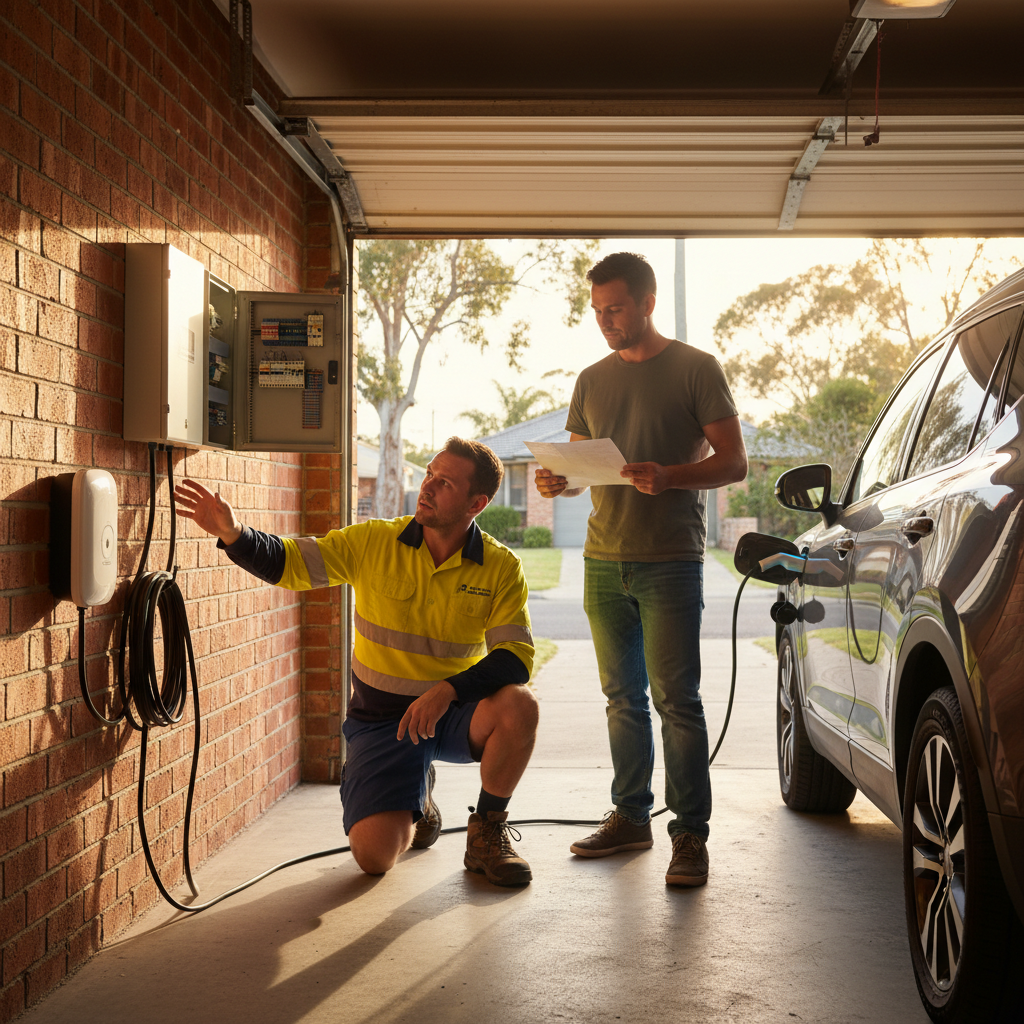
Home EV charging is now standard on most new EV purchases. The car comes with a granny lead (slow, plug into any power point) for emergencies, but daily charging really wants a proper wall charger on its own circuit. The total install cost varies a lot depending on your switchboard, your house, and what state you’re in.
Standard cost ranges, 2026
| Setup | Total install (AUD, incl GST) |
|---|---|
| 7kW Type 2 charger, single-phase, simple install | $1,200 to $2,200 |
| 7kW Type 2, single-phase, complex run | $1,800 to $3,000 |
| 7kW Type 2, with switchboard upgrade | $2,200 to $3,800 |
| 22kW Type 2, three-phase | $3,500 to $5,500 |
| 22kW Type 2, three-phase, with switchboard + service upgrade | $5,000 to $8,500 |
| Tesla Wall Connector | $1,500 to $3,200 typically |
| Add: dedicated meter for off-peak tariff | $400 to $900 |
| Add: smart load management (avoids tripping main fuse) | $600 to $1,500 |
These cover the charger unit + installation + Certificate of Compliance. Some installers bundle the unit and labour; others itemise.
What you’re actually paying for
- The charger itself: $600 to $2,500 depending on brand and features
- Cable run from switchboard to the charger location: $30 to $90 per metre, depending on cable size and routing
- Switchboard work: new RCBO/MCB combination, $150 to $400 if existing board has space
- Switchboard upgrade: $1,000 to $3,500 if existing board lacks space or is undersized
- Sparky labour: $400 to $1,200 for a standard install
- Certificate of Compliance: included in most quotes
- DNSP application (if needed): $200 to $600 for the distribution network operator to approve the connection
Single-phase vs three-phase
Most Aussie houses are single-phase, capped at 7kW for EV charging. That’s enough for overnight charging of any EV. Three-phase is faster (22kW) but requires:
- Three-phase supply at the property (rare in older houses)
- Three-phase switchboard
- DNSP approval (the distribution network operator must approve the load)
For most home users, single-phase 7kW is enough. The car charges fully overnight. The only reason to go three-phase is fleet use or specific cars (e.g., older Renault Zoe, certain Audi e-tron) that benefit from higher home AC charge rates.
The hidden cost: switchboard
The biggest single cost driver is the switchboard. Many Australian houses built before 2000 have switchboards that can’t take a new 32A circuit safely. The sparky will check during the quote visit. Typical outcomes:
- Board has space and capacity: cheap and easy, $150 to $400 added
- Board has space but is old/unsafe: full upgrade, $1,200 to $2,500
- Board has no space: full upgrade, $1,500 to $3,500
- Service mains are undersized: utility-side upgrade required, $1,500 to $4,000 plus utility fees
A surprise switchboard upgrade can double your EV charger budget. Always get the sparky to inspect before committing.
State rebates and incentives, 2026
- VIC: ACT Sustainable Household Scheme zero-interest loan covers EV chargers in eligible installs. Solar Homes rebate has at times included EV chargers.
- ACT: Sustainable Household Scheme zero-interest loans up to $15,000 cover EV chargers among other upgrades
- NSW: episodic incentives via state transport department, check current programs
- QLD: limited current incentives
- WA, SA, TAS, NT: no significant residential EV charger rebate as of mid-2026
Always check current programs at your state energy or transport department before committing.
Choosing a charger
Three big factors:
- Type 2 socket vs tethered cable: tethered is convenient, socket means any future car works without buying a new cable
- Smart features: load management, scheduling, app control, solar integration. Worth the premium if you have rooftop PV
- Brand reputation: Tesla Wall Connector, Wallbox Pulsar, ABB Terra, Smappee, Schneider, Delta. Stick to known brands with Aussie warranty support
Avoid:
- Generic Chinese brands without Aussie certification (the RCM compliance mark)
- Anything without Wi-Fi if you want load management or solar integration
- “Universal” Type 1 + Type 2 dual chargers (most EVs are Type 2 in Australia, single-standard simpler)
Choosing an installer
EV charger install is licensed electrical work. Most chargers also require manufacturer-accredited installation for warranty purposes. Ask:
- Is the installer accredited by your charger brand?
- Are they on the New Energy Tech Approved Seller list (industry quality scheme)?
- Will they handle the DNSP application if required?
- Certificate of Compliance included?
- Warranty on labour (minimum 1 year)?
A standard 7kW EV charger on a switchboard with capacity is a $1,500 to $2,500 job. A complex install with switchboard work hits $3,000 to $4,500. Three-phase 22kW for serious power runs $4,000 to $8,500. Get three quotes from accredited installers, factor in any state rebates, and watch out for the switchboard surprise.
Frequently asked questions
How much does it cost to install a home EV charger?
$1,200 to $3,500 installed for a typical 7kW Type 2 wall charger on a single-phase Aussie home. Goes up to $4,500 to $6,500 for 22kW three-phase. Add $200 to $800 if a switchboard upgrade is needed.
Do I need a special circuit for an EV charger?
Yes. Home EV chargers run on a dedicated circuit from the switchboard, sized for the charger's rated current. Most installs add a 32A circuit (for 7kW chargers) or three-phase 32A (for 22kW). Existing power points are not suitable for serious daily charging.
How long does an EV charger install take?
Half a day to one day for a standard wall-mount on a single-phase house. Three-phase or runs over 15m of cable from the switchboard can stretch to one and a half days. Add planning permit time if your install needs DNSP approval (some 22kW installs do).
Are there rebates for home EV chargers?
Some. VIC has historically run residential EV charger rebates worth $500 to $1,000. ACT Sustainable Household Scheme offers interest-free loans covering EV chargers. NSW and QLD have run incentive programs episodically. Check your state's energy or transport department for current schemes.