
Master Builders Australia has cut its forecast for new home starts by 62,000, with fewer than 920,000 homes now expected to begin construction in the five years to 2030-31. That’s an 8.4 per cent write down on the numbers the industry body published in March, and it pushes the National Housing Accord even further out of reach.
The downgrade came in forecasts released on 1 October covering all three arms of the industry. Alongside the housing cut, Master Builders projects $331 billion worth of non-residential building work and $688 billion in engineering construction over the same five years. All three segments were marked down from March.
On the housing side, the body now expects a 262,000-home building deficit to build up over the full term of the Accord.
Master Builders Australia Chief Economist Shane Garrett put the downgrade down to decisions in the May 2026 Federal Budget, continued interest rate increases and the geopolitical environment, with little progress on the industry’s supply-side capacity.
Mr Garrett said:
“New home builders are in the eye of a perfect storm. It’s much harder to sell new homes when established dwelling prices are on the way down. This is made worse by the fact that builders have no room to reduce their costs because of the pressures arising from tradie shortages and escalations in the price of key building materials.”
He warned the rate cycle may not be finished.
“Interest rate rises have eroded prospects for new homes and made it much more expensive for our homebuilders to carry out work. Our economy’s abysmal productivity performance raises the risk that several more hikes will be needed to quell inflation. If this happens, prospects could worsen further,” he said.
Where the work still sits: public projects, resources, data centres
The non-residential number is the one bright spot, and it’s holding up for a simple reason: a lot of it is government money already committed.
“Demand for non-residential building is partially insulated by its substantial portfolio of public sector funded projects. The five years to 2030-31 should see $331.0 billion worth of non-residential work get carried out, slightly stronger (+2.9 per cent) than what we got over the past five years. Data Centres have emerged as one of the most interesting features in this part of the market,” Mr Garrett said.

Civil work splits the same way, with some sectors carrying the load and others going backwards.
“For civil and engineering construction, resources and utilities projects are expected to be the strongest performers. In contrast, both transport and recreation-related construction are looking at significantly less work compared with recent years,” he said.
For anyone reading a forecast to work out where next year’s invoices come from, that’s the sentence that matters. Resources and utilities up, transport and recreation down, and a growing share of the non-residential pipeline tied to public budgets rather than private developers chasing a sales rate.
Master Builders blames the Budget
Master Builders Australia CEO Denita Wawn said the forecasts show policy is heading the wrong way.
“Modelling confirms that the Budget will deprive us of many new homes over the years ahead, and force rents even higher. Master Builders raised the alarm early this year that this would be the result, the Government chose to proceed and now the consequences are clear,” Ms Wawn said.
She pointed to the cost load sitting on top of every house before a brickie turns up.
“New home building struggles to expand because of tradie shortages, reduced investment, declining productivity and regulation totalling up to $320,000 per new house,” she said.
Her ask is specific: “The Federal Budget tax changes that are pulling down supply and jeopardising the financial viability of projects, especially in the higher density sector, must be reversed. Builders are calling for a pro-construction agenda that removes unnecessary regulation, improves the investment environment and fixes the systems they rely on, including the National Construction Code, skilled migration settings and domestic training pathways.”
What a thinner detached pipeline feels like on the tools
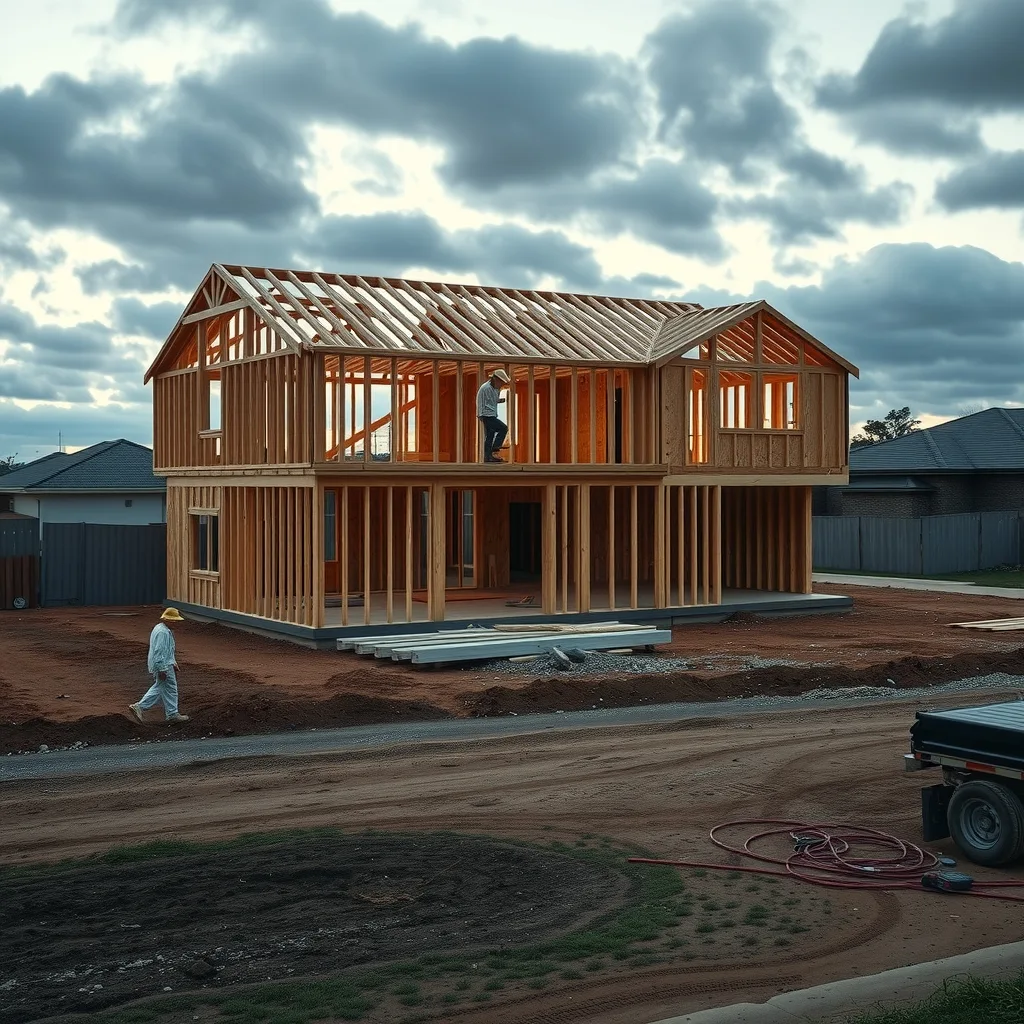
A housing downgrade doesn’t land evenly. It lands hardest on the crews whose whole year is tied to new-estate volume work: the slab crews, the frame-and-truss chippies, the roof tilers and the trades that follow them through a house in a fixed sequence, job after job, on a builder’s schedule of rates.
When starts thin out, that sequence gets gappy. The gap shows up as a fortnight between jobs instead of a Monday start on the next slab, and as more competition for the same estate contract, which is where margin goes first.
Garrett’s point about costs is the other half of it. If established house prices are easing while materials and labour aren’t, the builder can’t buy the job back by trimming the build cost. The squeeze runs straight down the contract chain to the subbies.
The flip side is the $331 billion non-residential figure and a civil pipeline weighted to resources and utilities. Those are different jobs, different inductions and often different hours than a housing estate, but they’re where the forecast says the volume holds.
Two things are worth watching between now and the next set of forecasts. One is the cash rate: Garrett has flagged the risk of further hikes, and the Reserve Bank meeting outcome moves new-home sales faster than almost anything else in this list. The other is whether the Budget tax changes Master Builders wants reversed get revisited. If you’re deciding right now whether to put on an apprentice, the forecast says the answer depends less on how busy you are this month and more on which side of the residential line your work sits.
Frequently asked questions
Why did Master Builders Australia cut its housing forecast?
It pointed to decisions in the May 2026 Federal Budget, continued interest rate increases and a difficult geopolitical environment, plus little progress on the industry’s supply-side capacity, according to chief economist Shane Garrett.
How far short of the National Housing Accord target is the new forecast?
Master Builders now expects a shortfall of 262,000 homes against the Accord’s target over the five years to 2030-31.
Which construction sectors are still doing well despite the housing downgrade?
Non-residential building, helped by public sector-funded projects and data centres, and civil sectors like resources and utilities are forecast to outperform, while transport and recreation construction are expected to see less work.
What does the downgrade mean for tradies working on new housing estates?
Trades tied to volume housing work, such as slab crews, frame-and-truss carpenters and roof tilers, are likely to see gaps between jobs and more competition for estate contracts as starts thin out.
Sourced from Master Builders Australia. Original article.