
What apprentices actually earn in Australia in 2026, trade by trade
Award pay rates for apprentice carpenters, electricians and plumbers jumped 4.75% on 1 July 2026. Here are the real weekly and hourly numbers by year of apprenticeship, plus the allowances and $10,000 government incentives that go on top.
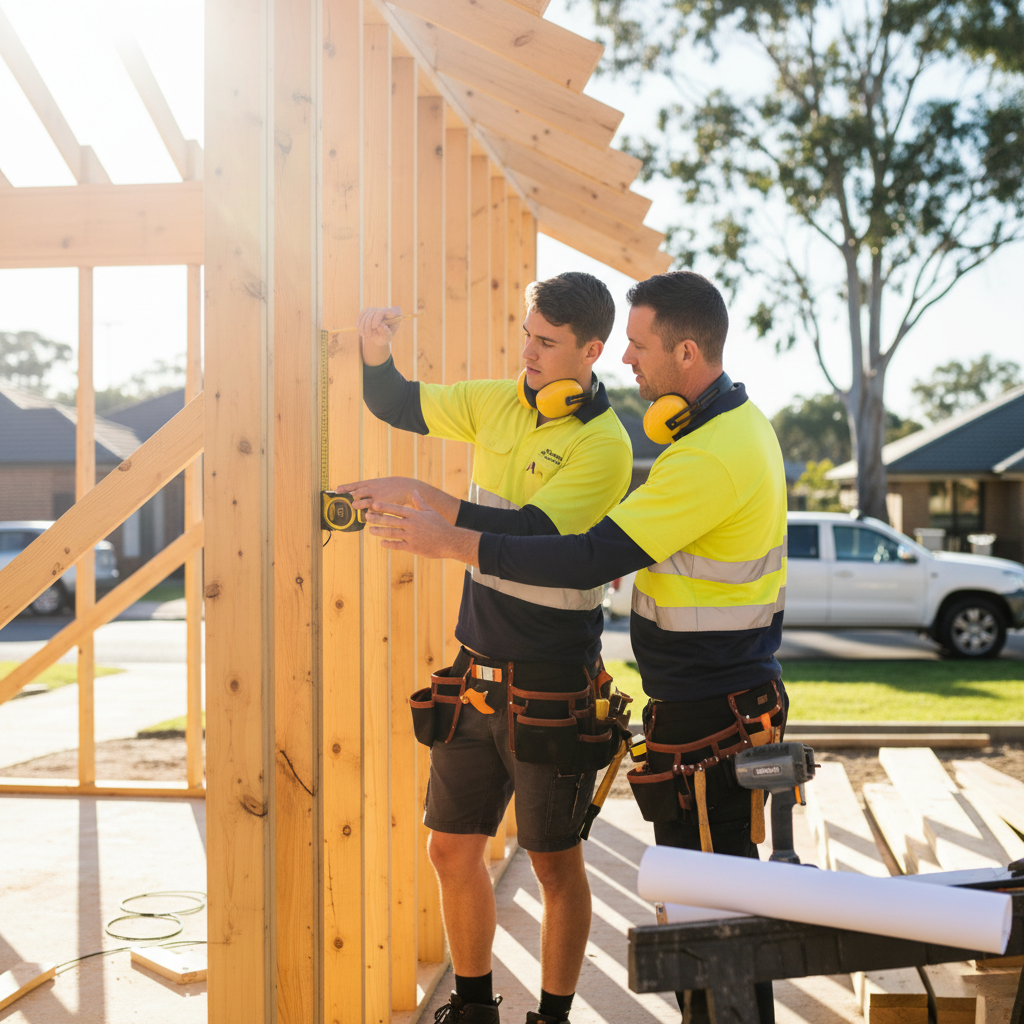
A first year apprentice in Australia earns between about $622 and $724 a week under the national awards from 1 July 2026, depending on the trade, whether they finished year 12, and the type of work. By fourth year that climbs to between $1,006.97 and $1,115.56 a week, and adult apprentices start higher again. All award minimum wages rose 4.75% on 1 July 2026 following the Fair Work Commission’s Annual Wage Review decision, which also lifted the national minimum wage to $26.44 an hour ($1,004.90 a week).
Those are the legal minimums, not the market. Busy commercial sites routinely pay above award, and government incentives can add up to $10,000 on top over the life of the apprenticeship. Here is how the numbers actually work.
How apprentice pay is set
Apprentice wages are not plucked from the air. Each trade’s modern award sets apprentice rates as a percentage of the qualified tradesperson’s rate (the “standard rate”). Under the Building and Construction General On-site Award, a four year apprentice who started after 1 January 2014 is paid:
| Stage | Did not complete year 12 | Completed year 12 |
|---|---|---|
| Stage 1 | 50% | 55% |
| Stage 2 | 60% | 65% |
| Stage 3 | 75% | 75% |
| Stage 4 | 90% | 90% |
Progression is competency based, not purely time based: you move to the next stage when you attain 25%, 50% or 75% of the competencies in your training plan, or 12 months after starting the previous stage, whichever comes first. Fast learners can move up early, and their pay must move with them.
The electrical and plumbing awards use their own scales, which is why the dollar figures below differ between trades even at the same year level. The percentages only matter for understanding the system; what you should check is the current dollar rate in the official Fair Work Ombudsman pay guides, which are updated after every annual wage review.
Building and construction apprentice rates for 2026
These are the minimum weekly and hourly rates for a four year carpentry (and general building trades) apprenticeship under the Building and Construction General On-site Award (MA000020), effective from the first full pay period on or after 1 July 2026. The rates include the industry and tool allowances, which is how the Fair Work Ombudsman publishes them.
Residential work:
| Year | Weekly | Hourly | Approx annual |
|---|---|---|---|
| 1st year (no year 12) | $654.49 | $17.22 | $34,000 |
| 1st year (year 12) | $710.45 | $18.70 | $36,900 |
| 2nd year (no year 12) | $766.40 | $20.17 | $39,900 |
| 2nd year (year 12) | $822.36 | $21.64 | $42,800 |
| 3rd year | $934.27 | $24.59 | $48,600 |
| 4th year | $1,102.13 | $29.00 | $57,300 |
Work that is not residential (commercial, civil and industrial) pays slightly more at every stage: $667.92 in first year without year 12, rising to $1,115.56 in fourth year. Annual figures above are the weekly rate multiplied by 52 and rounded; actual annual pay depends on overtime, RDOs and site allowances.
Electrical and plumbing apprentice rates for 2026
Electrical apprentices are covered by the Electrical, Electronic and Communications Contracting Award (MA000025). The published rates include the industry, tool and electrician’s licence allowances. From 1 July 2026:
| Year | Weekly (no year 12) | Weekly (year 12) | Hourly (no year 12) |
|---|---|---|---|
| 1st year | $622.72 | $682.76 | $16.39 |
| 2nd year | $742.79 | $802.84 | $19.55 |
| 3rd year | $862.87 | $862.87 | $22.71 |
| 4th year | $1,006.97 | $1,006.97 | $26.50 |
For context, a qualified grade 5 electrical worker under the same award is on $1,223.11 a week ($32.19 an hour) including those allowances, so a fourth year is on roughly 82% of a licensed sparky’s award package.
Plumbing apprentices fall under the Plumbing and Fire Sprinklers Award (MA000036). From 1 July 2026:
| Year | Weekly (no year 12) | Weekly (year 12) | Hourly (no year 12) |
|---|---|---|---|
| 1st year | $629.23 | $688.01 | $16.56 |
| 2nd year | $746.79 | $805.57 | $19.65 |
| 3rd year | $864.35 | $864.35 | $22.75 |
| 4th year | $1,099.48 | $1,099.48 | $28.93 |
The year 12 loading only applies in the first two years; from third year everyone is on the same rate. If you are weighing up the trades, our guides to becoming a carpenter, becoming an electrician and becoming a plumber cover the full pathway for each.
Adult apprentices start on much better money
Anyone 21 or over signing an apprenticeship is an adult apprentice, and the awards protect them from the junior scale. From 1 July 2026 an adult apprentice carpenter on residential work is on at least $1,108.44 a week ($29.17 an hour) for all years of the apprenticeship. An adult electrical apprentice starts on $982.95 and moves to $1,098.29 from second year onward. An adult plumbing apprentice is on $1,046.31 for the first three years and $1,099.48 in fourth year.
There is a second protection worth knowing: under the construction award, if you worked for your employer for at least six months full time (or 12 months part time or as a regular casual) before starting the apprenticeship, your ordinary hourly rate cannot be reduced because you signed a training contract. A labourer moving into a carpentry apprenticeship with the same builder keeps their labourer rate if it is higher.
Allowances and super that go on top
The headline rates above already include some allowances, but several more are paid separately under the construction award:
- Fares and travel allowance: $22.41 a day for tradespeople, scaled for apprentices at $16.81 (1st year), $19.05 (2nd), $20.17 (3rd) and $21.29 (4th) for every day you attend work
- Industry allowance: $1.41 an hour on residential work and $1.77 an hour on other construction (already built into the published rates)
- Tool allowance: $1.08 an hour for carpentry trades (also built in), plus reimbursement for training fees and textbooks for prescribed courses
- Superannuation: the super guarantee is 12% of ordinary time earnings from 1 July 2025, paid on top of wages
School-based apprentices are covered too: they get the same hourly rate as a full time apprentice for hours worked, plus payment for deemed off-the-job training time equal to 25% of the actual hours worked on the job each week.
Do apprentice wages really vary by state?
Less than most people think, and this is the most common misconception about apprentice pay. The awards above are federal instruments that apply nationally: a first year apprentice chippy in Hobart has the same award minimum as one in Perth or Cairns. There are no separate state award rates for these trades in the national system.
What does vary by state is everything around the minimum: enterprise agreements on commercial and civil jobs (typically well above award, especially in Victoria and NSW), how tight the local labour market is, TAFE fee subsidies, and state completion bonuses and tool grants. So two apprentices in different states can take home very different money while sitting on identical award floors. Always check your actual entitlement with the Fair Work Ombudsman’s pay tools rather than a mate’s payslip from another state.
Government incentives in 2026
The big one is the Key Apprenticeship Program. Since 1 July 2025 it has paid apprentices in eligible housing construction and clean energy occupations up to $10,000 on top of wages, in $2,000 instalments at 6, 12, 24 and 36 months and on completion. Carpentry, plumbing and electrical are all on the eligible list, more than 32,000 apprentices have been supported so far, and employers of eligible apprentices can claim up to $5,000 in the first year. Eligibility and the current occupation list are on the official Australian Apprenticeships site.
Living away from home allowances, travel support for block release training (your employer must cover excess reasonable travel and accommodation costs for required overnight training), and state top-ups can add more. None of it changes the core picture: apprentice pay starts modest, climbs every stage, and the fourth year rate now sits within about 10% of a qualified tradie’s award package in all three big trades.
Frequently asked questions
How much does a first year apprentice earn in Australia in 2026?
Under the national awards from 1 July 2026, a first year building and construction apprentice on residential work earns at least $654.49 a week ($710.45 if they finished year 12), a first year electrical apprentice at least $622.72 ($682.76 with year 12), and a first year plumbing apprentice at least $629.23 ($688.01 with year 12). That is roughly $32,000 to $37,000 a year before overtime, allowances and super.
Do apprentice wages change from state to state?
The minimum rates do not. Modern awards like the Building and Construction Award are federal instruments that apply nationally. What changes by state is what employers actually pay above the minimum, enterprise agreement coverage on commercial sites, and state training subsidies and completion bonuses.
What does an adult apprentice get paid?
More. From 1 July 2026 an adult apprentice carpenter on residential work gets at least $1,108.44 a week for every year of the apprenticeship, and an adult electrical apprentice gets $982.95 in first year and $1,098.29 after that. If you worked for the employer for at least six months full time before signing up, your pay cannot drop below what you were already earning.
Do apprentices get paid for TAFE days?
Yes. Time spent at training or assessment required under the training contract counts as time worked, so block release and day release at TAFE are paid at your normal rate. Employers must also reimburse course fees and textbook costs for prescribed courses under the construction, electrical and plumbing awards.
Do apprentices get superannuation?
Yes. Apprentices are employees, so the superannuation guarantee applies. The rate is 12% of ordinary time earnings, the final legislated step, which took effect on 1 July 2025.
What is the $10,000 apprentice incentive?
The Key Apprenticeship Program pays eligible apprentices in housing construction and clean energy occupations up to $10,000 in five instalments of $2,000 at 6, 12, 24 and 36 months and on completion. It has supported more than 32,000 apprentices since it started on 1 July 2025.