
Heat pump vs gas vs electric hot water, which is best for Australian homes in 2026?
Heat pumps are taking over Aussie hot water, with state rebates worth thousands. Here's how the three options stack up on running cost, install cost, and lifespan in 2026.
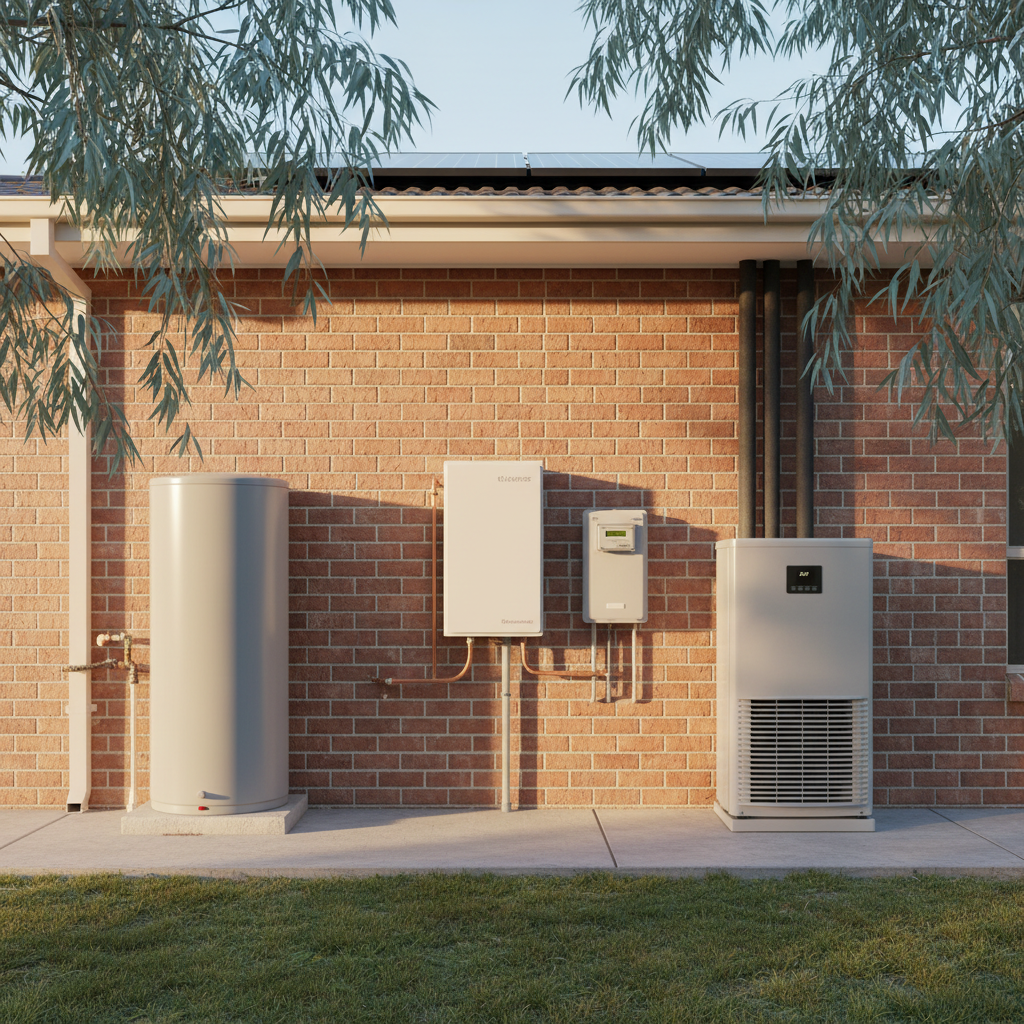
Hot water is the single biggest energy cost in most Australian houses, accounting for 20 to 30% of the bill. The three mainstream options in 2026 are heat pump, gas (instantaneous or storage), and electric storage. With state rebates and rising gas prices, the maths has shifted hard towards heat pumps over the past three years.
This is a national comparison. Your state’s rebates and your house’s setup move the verdict.
The three options, at a glance
| Heat pump | Gas instantaneous | Gas storage | Electric storage | |
|---|---|---|---|---|
| Install cost (typical 4-person family) | $3,000 to $5,500 (after rebates) | $2,200 to $4,000 | $1,800 to $3,500 | $1,400 to $2,800 |
| Annual running cost | $150 to $400 | $400 to $800 | $500 to $1,000 | $700 to $1,500 |
| Lifespan | 10 to 15 yrs | 12 to 20 yrs | 10 to 15 yrs | 8 to 15 yrs |
| Replaces solar HW well? | Yes | Sort of | Yes | Yes |
| Works with PV solar? | Excellent | Limited | No | Good (during day only) |
| Risk of gas price rise | None | High | High | None |
Heat pump, the 2026 default
The federal Small-scale Technology Certificate (STC) scheme plus state schemes (NSW Energy Savings, VIC Solar Homes, ACT Sustainable Household) effectively subsidise heat pumps by $1,500 to $4,000. Real-world install cost for a Sanden, Reclaim Energy, or similar mid-range heat pump for a family of four is $3,000 to $5,500 after rebates.
Running cost is the killer feature. A heat pump uses 1 unit of electricity to move 3 to 4 units of heat. That’s why running costs are a third of electric storage. With rooftop solar self-consumption, run during the day for free.
The downsides:
- Outdoor unit takes up wall space and runs a fan (gentle hum, not loud)
- Refrigerant systems are sensitive to install quality, get a Heat Pump Pilot Program-accredited installer
- Cold weather performance dips in Tasmania, Canberra, and the Snowy region (still works, just less efficient)
Gas, the comfortable but rising-cost option
Gas hot water (especially instantaneous) is the traditional Australian default. Comfortable, predictable, no refrigerant systems to fail. But:
- Gas prices in Australia have doubled since 2020 and the trend is steeply up
- Several jurisdictions have banned new gas connections (VIC residential from 2024, ACT phasing out)
- Falling gas demand means network costs are rising for those who stay
- Most installs need annual servicing for warranty validity
Gas instantaneous is still the right pick if you already have gas, don’t have outdoor space for a heat pump, or live somewhere where electricity is unreliable.
Electric storage, the cheapest install, most expensive to run
Plain electric storage (a big insulated tank with a heating element) is the legacy default in many older Aussie houses. Cheap to install. Cheap units. Reliable. But running costs are now genuinely punishing on flat tariffs, and the running cost gap versus heat pump pays back the heat pump premium in 2 to 4 years for most families.
The exception: small households (1 to 2 people) or holiday homes where the unit is rarely used. Cheap install plus low use makes electric storage still competitive there.
Solar hot water, the niche option
Solar thermal hot water (panels on the roof heating a tank) used to be the smart choice. Modern PV-driven heat pumps have basically replaced it: cheaper install, same running cost, doesn’t require roof orientation, easier service.
Existing solar hot water installations are still worth maintaining (replacement tanks $1,200 to $2,500) but new installs almost always go heat pump.
The state-by-state rebate position (2026)
- NSW, Energy Savings Scheme + STCs combine for $1,500 to $3,500 off heat pump installs
- VIC, Solar Homes hot water rebate $1,000 + STCs, around $2,500 to $4,000 off
- ACT, Sustainable Household Scheme zero-interest loan up to $15,000 covers heat pump + other upgrades
- QLD, no state rebate currently, federal STCs only
- SA, modest state rebate plus STCs
- TAS, low rebates currently, but Hydro Tas off-peak rates make heat pumps very cheap to run
- WA, NT, federal STCs only
Always check the current scheme before paying. The rebate amount changes annually and sometimes mid-year.
Choosing for your house
| Your situation | Probably best |
|---|---|
| New build, all-electric, with PV solar | Heat pump |
| Replacing failed gas instantaneous, kept gas connection | Gas instantaneous or heat pump |
| Replacing failed electric storage | Heat pump |
| Holiday home, low usage | Electric storage |
| Apartment with no outdoor space | Gas instantaneous (if connection exists) |
| Off-grid or unreliable mains | Solar thermal + electric backup |
| Building in VIC after 2024 | Heat pump (gas connections banned in new builds) |
2026 prices to install (licensed plumber + sparky)
A new heat pump install runs typically:
- Unit itself: $2,500 to $4,500
- Plumber labour (4 to 6 hours): $700 to $1,200
- Electrician (new circuit, 2 to 3 hours): $400 to $700
- Disposal of old unit: $80 to $200
- Pad, mounting, condensate drain: $150 to $400
Total before rebates: $4,000 to $7,000. After rebates: $3,000 to $5,500 for most situations.
All of this is licensed work. Don’t DIY hot water systems, the consequences of failure include scalding injuries, water damage, and voided insurance.
Frequently asked questions
Is a heat pump worth it for a typical Aussie home?
Yes, for most households on flat tariffs. Federal STC rebates plus state rebates (NSW, VIC, ACT all run major schemes in 2026) cut the install cost by $1,500 to $4,000. Running cost is roughly a third of electric storage and half of gas. Payback period 4 to 7 years against gas, 2 to 4 years against electric storage.
What's the cheapest hot water to run?
Heat pump with off-peak tariff and solar self-consumption. Annual running cost $150 to $400 for a typical family of four. Gas instantaneous runs $400 to $800. Electric storage on flat tariff runs $700 to $1,500.
Can I replace gas with a heat pump?
Yes. Most existing gas hot water installations can be replaced with a heat pump in the same location, with the gas line capped. The plumber and an electrician handle it (heat pumps need a power circuit). All licensed work.
How long does a hot water system last?
Electric storage 8 to 15 years. Gas instantaneous 12 to 20 years. Heat pump 10 to 15 years. Solar hot water 15 to 25 years with tank replacements.