
How to install a Colorbond fence, Aussie weekend DIY guide
Colorbond is the standard Aussie boundary fence material. Here's how to install it yourself on a typical residential boundary, plus when to call a fencing contractor.
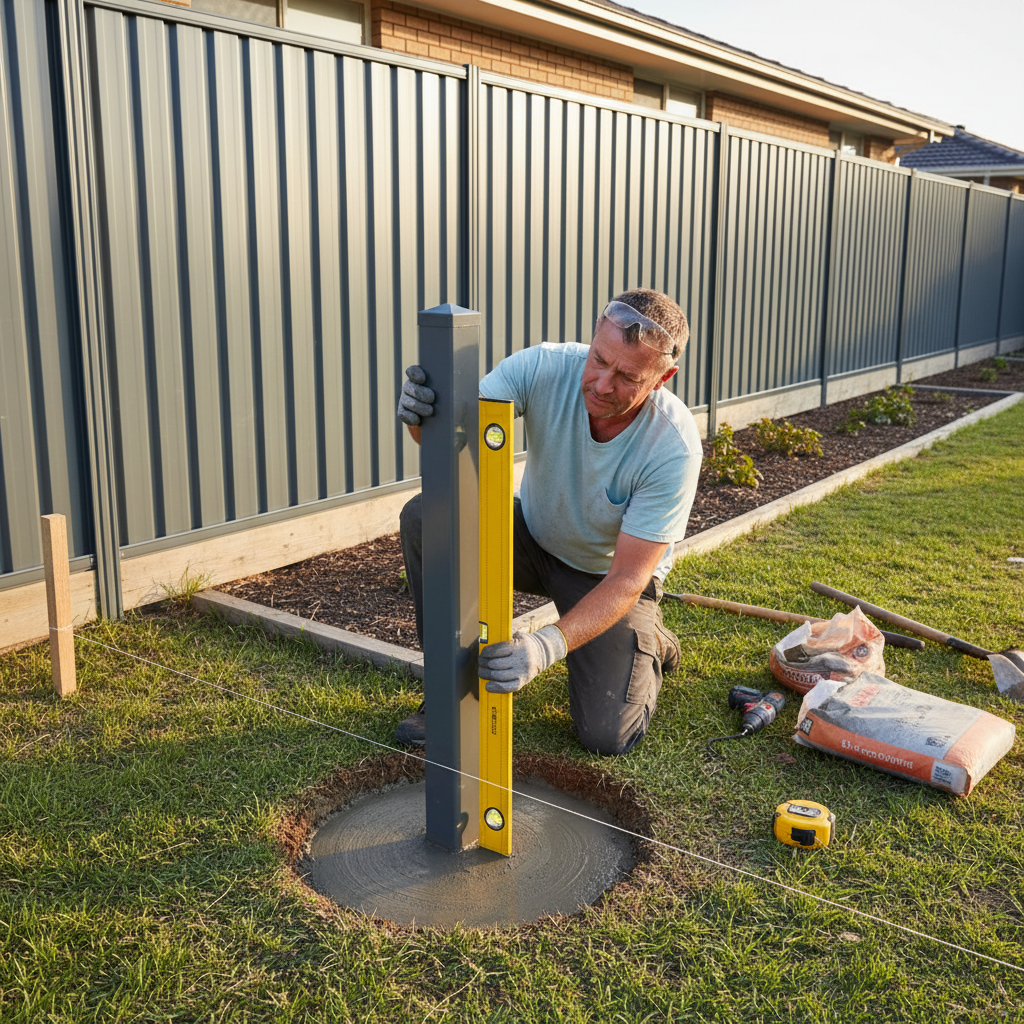
Tools and materials
Tools
- Post-hole digger (manual or hired auger)
- Spirit level (600mm and 1.2m)
- Tape measure
- Hammer or rubber mallet
- Drill with metal bits
- Tin snips
- Stringline
- Crowbar
Materials
- Colorbond posts (galvanised steel, length = fence height + 600mm ground)
- Colorbond rails (top and bottom)
- Colorbond sheeting
- Concrete (20kg bags or premix)
- Tek screws and brackets
- Cap strips
Colorbond is the default boundary fence material in Australian suburbs. Six million metres of it goes up every year, and a chunky portion is DIY. The job is repetitive and tiring rather than skilled, no specialist tools or licensing required for standard residential boundaries.
This is genuinely DIY work in every Australian state for normal residential dividing fences. The exceptions are corner-block fences affecting sight lines, fences in heritage areas, fences over 1.8m, and fences taller than that. Those need council approval and often a registered builder.
The fence in plain language
A Colorbond fence is three things:
- Posts (vertical steel, set in concrete in the ground)
- Rails (horizontal steel between posts, top and bottom)
- Sheeting (vertical Colorbond panels between rails)
Plus end caps, cap strip, gates if you want them. The skill is in setting the posts plumb, level, and at consistent spacing.
The four-step build
- Set out and dig, mark the boundary, dig holes 600mm deep at 2.4m centres
- Set the posts, posts vertical and plumb, concrete in
- Fit rails, screw top and bottom rails between posts
- Slide sheets, drop Colorbond sheets into the rails, fix with tek screws, top with cap strip
A 20m fence (8 to 9 posts) takes a fit DIYer two weekends. A contractor with a crew does it in a day.
Cost breakdown for a 20m fence
| Item | Cost (AUD) |
|---|---|
| Posts (8 to 9, $40 to $80 each) | $320 to $720 |
| Rails (top and bottom, $90 to $140 per length) | $360 to $560 |
| Sheets (20m at $80 to $130/m) | $1,600 to $2,600 |
| Concrete (10 to 12 bags 20kg, $8/bag) | $80 to $100 |
| Tek screws, brackets, cap strip | $80 to $150 |
| Tool hire (auger if not borrowing) | $80 to $200 |
| DIY total | $2,500 to $4,300 |
Contractor fencing pricing tends to run $80 to $140 per metre installed, so a 20m fence is $1,600 to $2,800 in labour on top of materials. Total contractor quote $4,000 to $6,500 for 20m. DIY saving: $1,500 to $2,500.
The neighbour conversation
Most Australian fences are dividing fences. Under the Dividing Fences Act in each state, you and your neighbour share the cost of a “sufficient dividing fence”. Before starting:
- Write to your neighbour with a quote
- Give them time to respond (the Act sets the window, usually 30 days)
- If they agree, get the cost-share in writing
- If they refuse, you can apply to the relevant tribunal for an order
- If they’re absent or unreachable, document your attempts to contact
Without this, you can still build the fence, but you can’t enforce cost-sharing.
When to call a contractor
- The fence is on a steep slope (stepped or raked, more complex than DIY usually handles)
- The boundary has trees, rocks, or other obstructions
- You need a long run done fast
- Corner block fences affecting sight lines (council usually requires licensed)
- Acoustic fences (taller, denser, requires structural engineering in most cases)
- You don’t want to spend two weekends digging post holes in summer
For a standard 15 to 25m flat-ground boundary, DIY is genuinely the right call for most fit homeowners.
Frequently asked questions
Do I need council approval for a Colorbond fence?
Usually yes if over 1.8m high, on a heritage-listed property, or on a corner block (where it affects sight lines). Standard 1.8m residential fences along internal boundaries are typically exempt under most council rules. Always check before starting. Side and rear boundary fences also fall under each state's Dividing Fences Act, which requires neighbour negotiation if you want them to contribute.
Can I do my own fence or do I need a fencing contractor?
Standard residential boundary fences are squarely DIY territory. A contractor licence isn't needed in any state below the dollar value threshold (typically $5,000 in NSW, $3,300 in QLD). The work is mostly digging, levelling, and cutting metal. Where DIY gets hard is on slopes, around obstructions, or for very long runs where speed matters.
How long does a Colorbond fence last?
20 to 30 years for the steel itself in most Australian conditions. Coastal areas (within 1km of saltwater) see faster fading and corrosion of fixings, replace tek screws with stainless steel if you're near the coast. Posts in poorly-drained ground rust at the base first, dig deep enough and concrete properly.
How do I work out fence cost-sharing with my neighbour?
The Dividing Fences Act in each state sets the framework. You're entitled to half the cost of a 'sufficient dividing fence' from your neighbour. If they refuse, you can apply to the relevant tribunal (NCAT in NSW, VCAT in VIC, QCAT in QLD) for an order. Get the request in writing before starting. Save quotes and receipts.