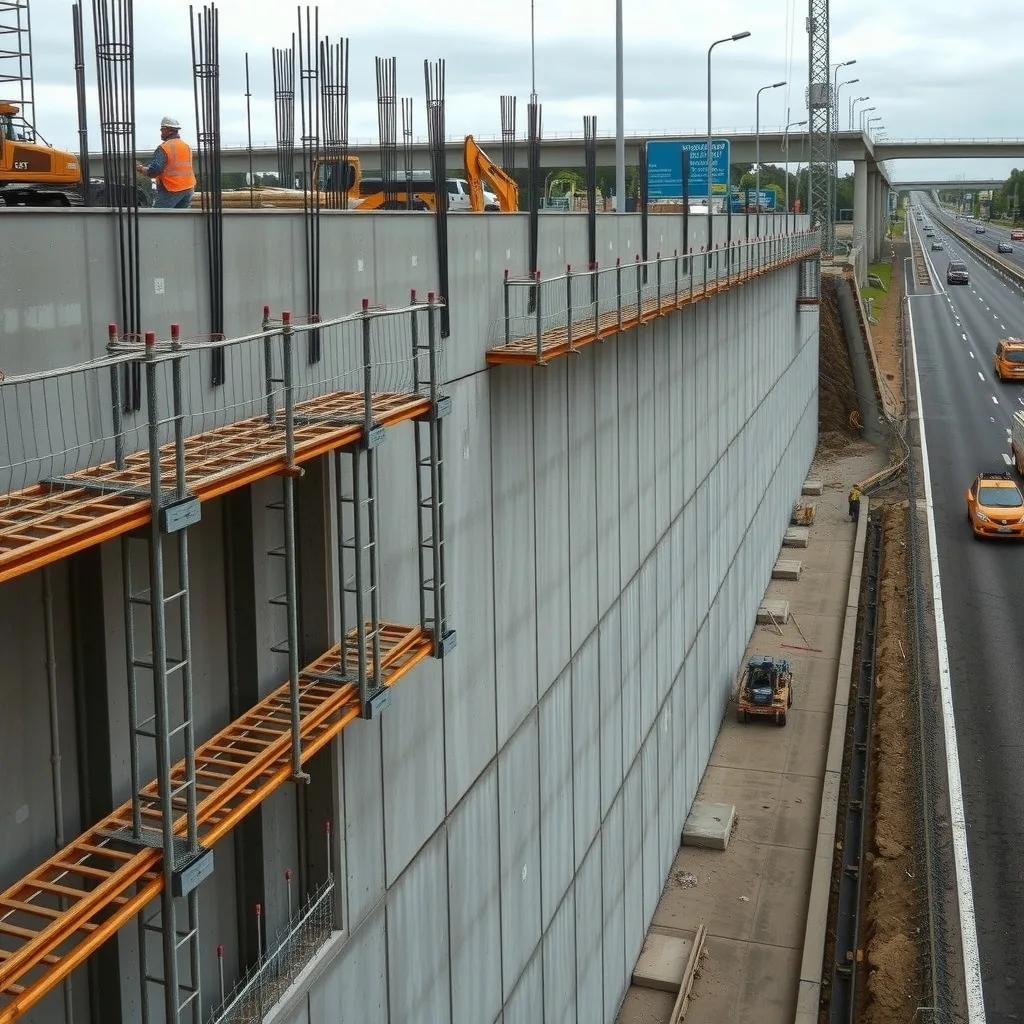

Retaining wall panels on Melbourne’s M80 Ring Road Completion are going in with 29 per cent less concrete and 10 per cent less steel reinforcement after an Australian-first application of recycled plastic void formers, cutting the panels’ associated carbon emissions by 15 per cent. The walls support the new interchange that ties into the North East Link tunnels.
The detail comes from Infrastructure magazine, which reported the Robovoid system is being used on the project to shave concrete volume out of panels while keeping the structural job the same. The M80 Ring Road Completion, part of North East Link, is building the freeway connection between the M80 and the Eastern Freeway to give freight a direct run and take trucks off local roads in Melbourne’s north-east.
What a void former actually does to a panel
The idea isn’t complicated. Void formers occupy space inside a concrete section that would otherwise be filled with concrete doing very little structural work, so the section keeps its depth and stiffness while the mix volume drops.
What’s different here is the material. Robovoid’s 3D geometric formers are made from 100 per cent recycled plastic, and according to Infrastructure magazine they can be recovered and recycled again once the structure reaches the end of its service life.
On a sustainability scorecard that’s two wins stacked on each other: less cement burnt to make the panel, and a slab of plastic waste parked inside infrastructure instead of landfill.
The numbers that matter on the pour
Here’s the citable one. Robovoid void formers cut concrete volume in M80 Ring Road Completion retaining wall panels by 29 per cent, steel reinforcement by 10 per cent and associated carbon emissions by 15 per cent, Infrastructure magazine reported in October 2026.
Put it in trade terms. Roughly speaking, for every four cubic metres you would have placed in a panel, you’re now placing closer to three. That’s fewer agitator loads through the gate, less pump time, and less of the batch-plant lead time that normally sets the rhythm of a wall program.
It doesn’t make the formwork or steel crews redundant. The cages still get fixed, the panels still get formed, and the practical questions are the usual ones for any voided section: how the formers are held in position while the pour goes in, and how compaction is managed around them. The published account doesn’t go into the site method, so don’t assume it’s a drop-in on your next job.
Why state jobs are chasing this
Sustainability ratings are no longer a nice line in the tender document. The M80 Ring Road Completion has achieved a platinum design rating of 88.7 from the Infrastructure Sustainability Council, and its use of Robovoid contributed to a nomination for an ISC sustainability award.
That’s the mechanism worth watching. When head contractors are scored on embodied carbon, the specification flows down to the people placing the concrete, and systems that take cubic metres out of a pour start appearing in subcontract scopes rather than in conference papers.
The background numbers explain the pressure. Concrete production is estimated to account for between 8 and 10 per cent of global emissions, while Australia recycles around 13 per cent of its plastic waste, Infrastructure magazine reported. Any product that moves both of those lines at once has an easy story to tell a client.
What to watch
The test is whether this stays a one-project showcase or turns up in the next round of Victorian civil tenders. Concreting and reinforcement subbies bidding on major state road work should expect embodied-carbon targets to keep tightening, and should read scopes closely for void systems that change how a panel gets built rather than just what goes in the mixer.
If you’re pricing retaining wall work, the volume saving is the headline, but the labour sequence around the formers is where the margin will be won or lost.
Frequently asked questions
What does a void former do inside a concrete panel?
It occupies space inside a concrete section that would otherwise be filled with concrete doing little structural work, so the panel keeps its depth and stiffness while using less concrete.
Are Robovoid formers recyclable?
Yes. They’re made from 100 per cent recycled plastic and, according to Infrastructure magazine, can be recovered and recycled again once the structure reaches the end of its service life.
How much concrete and steel did the M80 project save?
Retaining wall panels used 29 per cent less concrete and 10 per cent less steel reinforcement, cutting associated carbon emissions by 15 per cent, Infrastructure magazine reported.
Sourced from Infrastructure magazine. Original article.