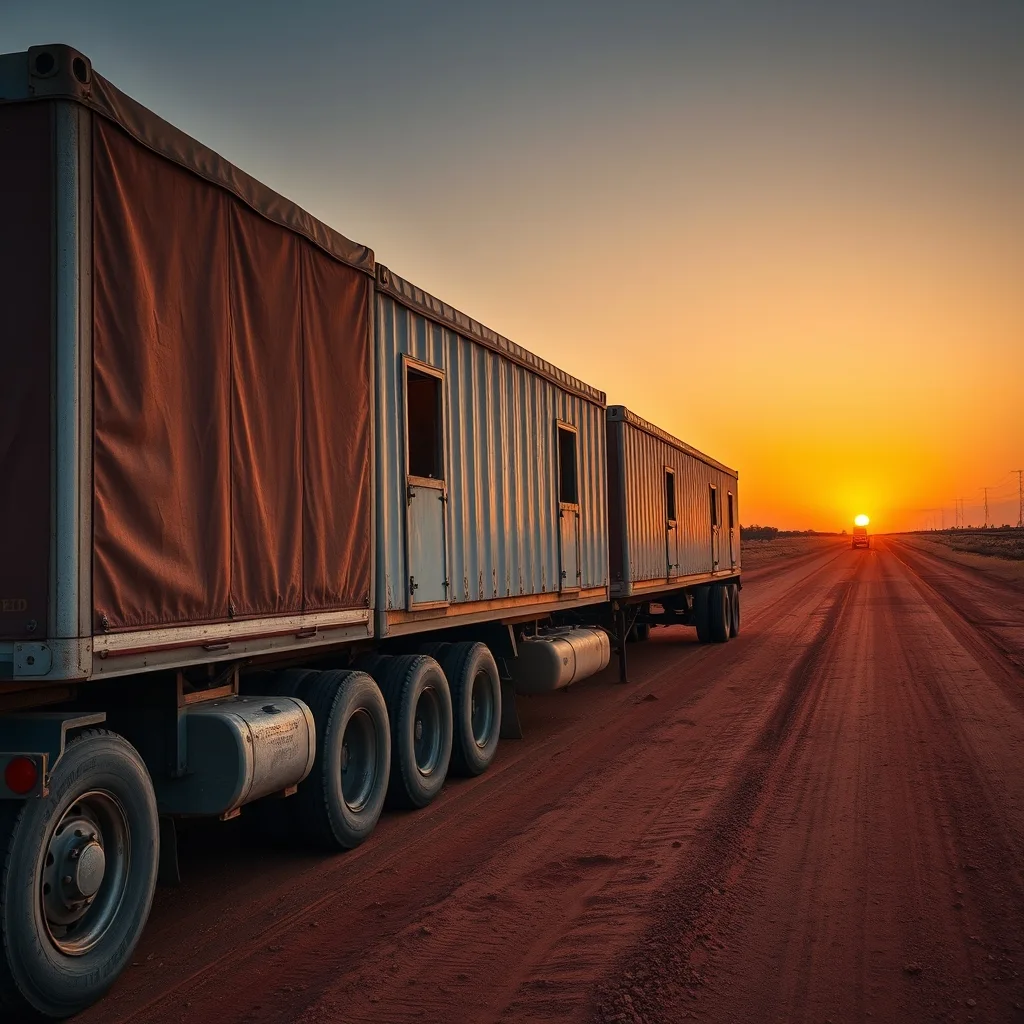

A tiny Queensland shire is housing its road workers in fully fitted-out triple-trailer road trains, a practical fix for a region that can’t afford to keep losing skilled workers to mining.
Barcoo Shire Council covers roughly 61,974 sq km of far west Queensland, comparable in size to Tasmania, with a population of around 360 people. Worksites sit 300 to 400 kilometres from the nearest town, so the council runs three mobile camps: one currently on the Quilpie to Windorah Road, one at Windorah, and a third further west toward Birdsville. ABC Western Queensland reported on the setup this week.
Each camp runs entirely off-grid and can be deployed anywhere in the state. The road trains are fitted with bedrooms and ensuites, kitchens, dining areas, laundries, and streaming TV through shared and personal screens. Moving is quick. “We back the trucks underneath, they’re all on cables. They just lift all the verandahs up, and we move,” says Jason Beilby, construction supervisor with Barcoo Shire Council, who has worked Queensland roads for about 20 years.
Beilby has watched conditions evolve. “Ten years ago we were very rough camps. We were living in the bush … and we found that to employ people we just had to upgrade, and that’s fair enough.” After twelve hours on the bitumen in outback heat, workers want somewhere decent to land. “Twelve hours out in the sun [and] you do want to come home to comfort, and that’s a good sales point for employees to get them to come here and work,” he said.
Road worker Dolly Thompson, who spends weeks and sometimes months in some of Queensland’s most remote corners, is direct: “You’re better off being out in the camp than what you are in town.”
The stakes are real. Barcoo is currently delivering around $60 million in road recovery works following a major flood event in March 2025, and recently pushed back against proposed changes to federal disaster recovery funding that it says would have stripped the shire of roughly $15 million in Commonwealth support. Holding onto a competent road crew isn’t just a workforce problem, it’s a financial one. Peer-reviewed research published in 2026 in Humanities and Social Sciences Communications found that skill shortages, uncompetitive wages, and poor amenity are the chief barriers stopping tradespeople from taking regional local government work.
Beilby thinks the model should spread. “I think all shires should upgrade, but it depends on their structure.” For remote councils across Queensland, WA, the NT, and South Australia struggling to retain road workers, plant operators, and maintenance crews, purpose-built mobile camps that match mining standards could be one of the more practical tools on the table.
Frequently asked questions
How do Barcoo Shire’s mobile road-train camps work?
Each camp is built into triple-trailer road trains fitted with bedrooms, ensuites, kitchens, dining areas, laundries, and streaming TV. When it’s time to move, trucks back underneath the trailers, cables lift the verandahs, and the whole camp relocates to the next worksite.
Why does Barcoo Shire need mobile camps instead of housing workers in town?
Worksites in Barcoo can be 300 to 400 kilometres from the nearest town. Mobile camps let crews stay on-site rather than commuting impractical distances across one of Queensland’s most remote shires.
Could other remote councils use a similar model?
Construction supervisor Jason Beilby says he thinks all shires should upgrade their worker accommodation, though he notes it depends on each council’s structure and resources. Researchers have identified poor amenity as one of the chief barriers to attracting tradespeople to regional local government roles.
Sourced from ABC Western Queensland, Barcoo Shire Council, Humanities and Social Sciences Communications. Original article.